

Project - Create report
On this page, you can create many types of reports about the project:
-
A progress report is an overview of how much of a project is done. It gives you a breakdown by segment status. In a multilingual project, you can run a progress report for all target languages or a single target language.
-
An analysis report counts words, characters, and segments in the source text of the whole project. It looks up every segment in the translation memories and LiveDocs corpora, and counts the different types of matches. You run this report when you prepare a project. It is often run automatically, especially from projects created from a template.
-
An analysis report including MT counts separates statistics for machine-translated content and content translated from translation memories and LiveDocs corpora, based on a match rate (set by the project manager). Practically, it sums all fuzzy matches below that match rate into a single category. It's useful in workflows that combine human and machine translation.
-
A post-translation analysis (PTA) report shows savings coming from TM and LiveDocs matches – after translation is complete. The regular analysis "predicts" how much you could save on matches. Post-translation analysis gives you the actual savings. It is also useful for finding out how much each translator can bill. You run this report after a project is delivered (or when at least one translator delivered all their work).
-
An edit distance report shows how much work a translator or a reviewer change the text.
-
A reviewer change report shows how much a reviewer edited the documents with tracked changes turned on.
-
A tracked changes report shows what reviewers changed in a project's translation. It compares two versions of files and shows what was changed.
-
An LQA overview report sums up the reviewers' feedback about the translation of the whole project. It lists each document in the project, and tells if they passed or failed the review.
-
An LQA error list report shows a summary table that lists the number of errors by category (detailed into subcategories) and severity. Below that, there is the list of segments that the reviewers rejected in each file in the project.
-
An LQA statistics report shows the number of errors. Grouping and details depend on the settings you choose when you create the report.
How to get here
- Log in to memoQweb as an administrator or a project manager.
- On the Active projects list, click a project.
- At the top of the screen, click the Reports tab.
- Above the report list, click the Create report link. The Create report page opens.
There are reports that can also be meaningful for files, not just the whole project: Analysis, Analysis including MT counts, LQA statistics, and LQA error lists. You create these reports for some files only on the project's Translations page.
What can you do?
 Choose the settings for an analysis report
Count how much a team of translators need to work on the project
Choose the settings for an analysis report
Count how much a team of translators need to work on the project
If several translators work on a set of documents, you can't know when a translator gets to translate a segment or a document. This means you also can't know who will be able to use translations from others. As a result, you cannot predict what internal repetitions will be used.
Bottom line: If the translation is done by a team rather than one single translator, you can't have a precise estimate of the work in advance. To find out the exact amount, use Post-translation analysis after the translation is finished.
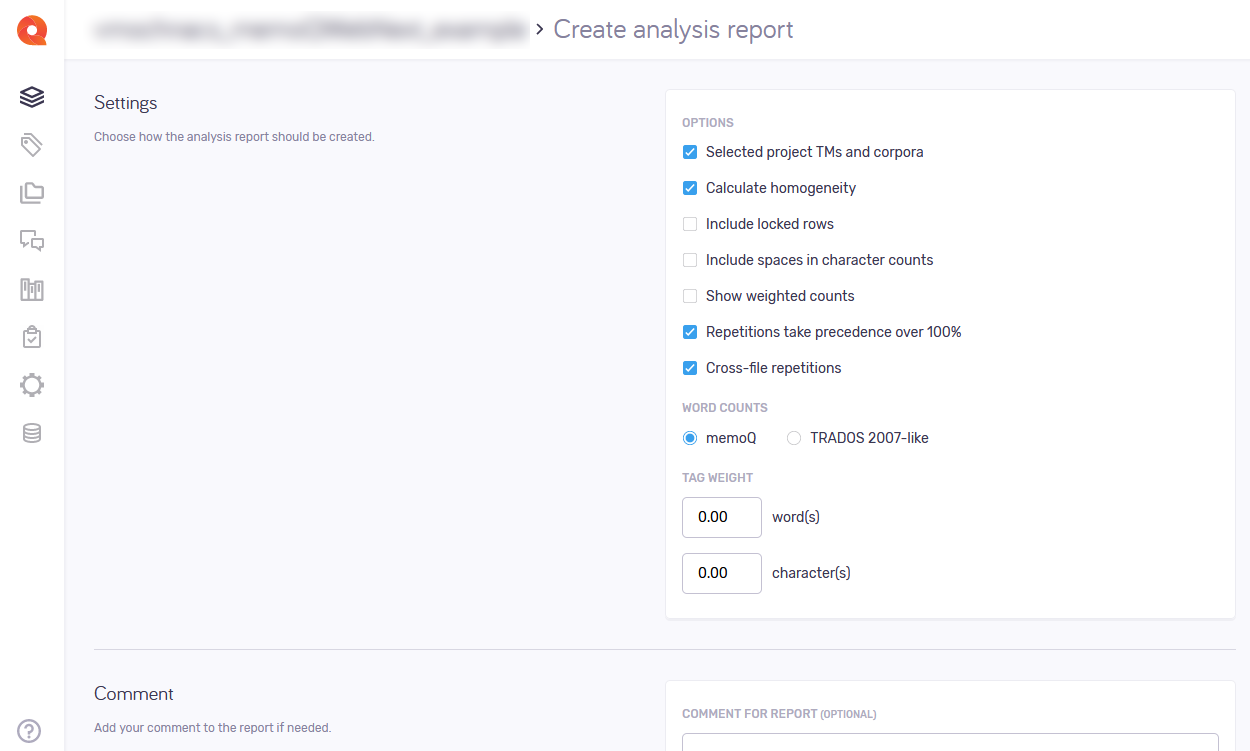
To set this up for your team: in the Settings section, use these options:
-
Select the
-
Clear the Calculate homogeneity checkbox. memoQ should not count internal fuzzy similarities because we don't know the order in which segments are translated.
-
Clear the Include locked rows checkbox: If you received documents that contain locked rows, most of the time your client means that you must not touch those.
-
Select the
-
Clear the
Count how much a single translator needs to work on the project
To set this up for a single translator: in the Settings section, use these options:
-
Select the
-
Select the Calculate homogeneity checkbox. memoQ counts internal fuzzy similarities, too. That is, memoQ predicts what matches the translator gets during translation while the translation memory is filled up.
Use this only if this job is really for a single translator: Don't select the Calculate homogeneity checkbox if two or more translators are assigned to this job.
-
Clear the Include locked rows checkbox: If you received documents that contain locked rows, most of the time your client means that you must not touch those.
-
Select the
-
Select the
Choose the settings for an analysis including MT counts report
-
In the Report type section, choose Analysis including MT counts from the dropdown.
-
-
Click Select TMs and LiveDocs corpora.
The Select TMs and LiveDocs corpora for pre-translation window opens:
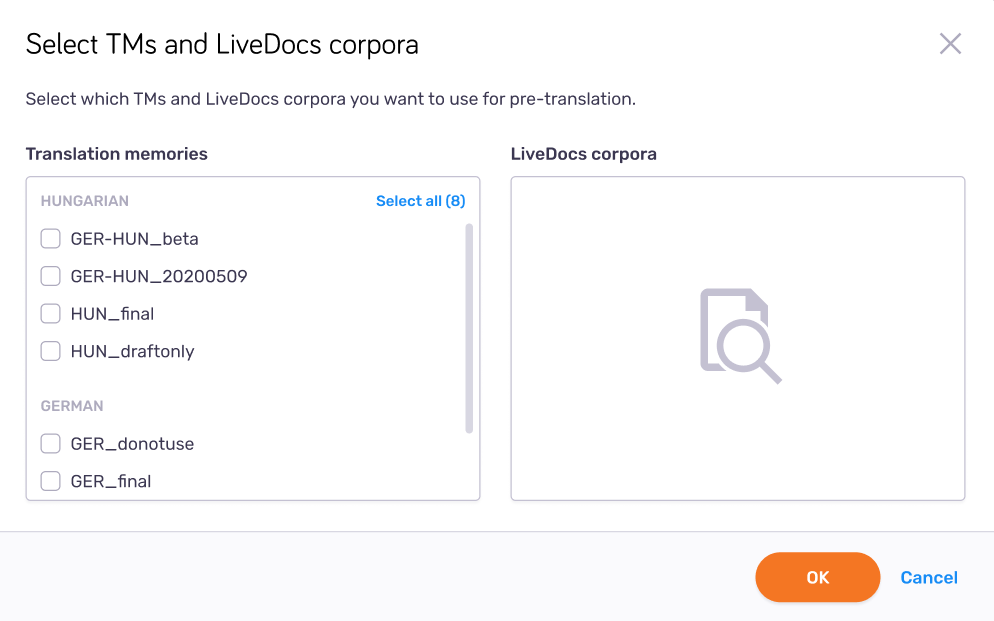
memoQ uses the TMs and corpora which have their checkboxes selected.
-
To select or clear the checkboxes for each TM or corpus, select or clear the Translation memories or LiveDocs corpora checkbox.
-
In the Settings section, choose how to create the report and what details to include:
The recommended settings are different when you work with one translator or a team. See the detailed explanation in the regular analysis report's description.
-
Use TMs and LiveDocs corpora from the project: memoQ checks the segments in every translation memory and LiveDocs corpus in the project.
-
Calculate homogeneity: memoQ collects internal fuzzy matches.
-
Include locked rows: Don't use this setting unless translators need to work also on locked content.
-
Include spaces in character counts is only relevant if you work with character counts, not word counts.
-
Show weighted counts: This setting gives more realistic work estimates.
-
Count 100% matches as repetitions: Use this setting only if a consistent translation is more important than using all possible matches from the translation memory.
-
Cross-file repetitions: memoQ counts repetitions not only within documents but across the whole project.
-
Count words like: Always choose memoQ here.
-
Count tags as: Type a number in the words or characters box (e.g., 0.25 words per tag or 2 characters per tag).
-
Tell memoQ which
Choose the settings for an edit distance report
On memoQweb, you can only compare Inserted matches vs. current translation. In the memoQ desktop app, there are more settings.
In the Report type section, choose Edit distance from the dropdown.
To give you an idea of how much the translator worked, this setting compares the translator's work to the translation memory matches that were inserted in the segments.
Check the Show results for each file checkbox to create a separate report for each file you have in the project. Created reports are more detailed and show all the edit distance scores by type (e.g., X-Translated, No match inserted, Machine translated etc.)
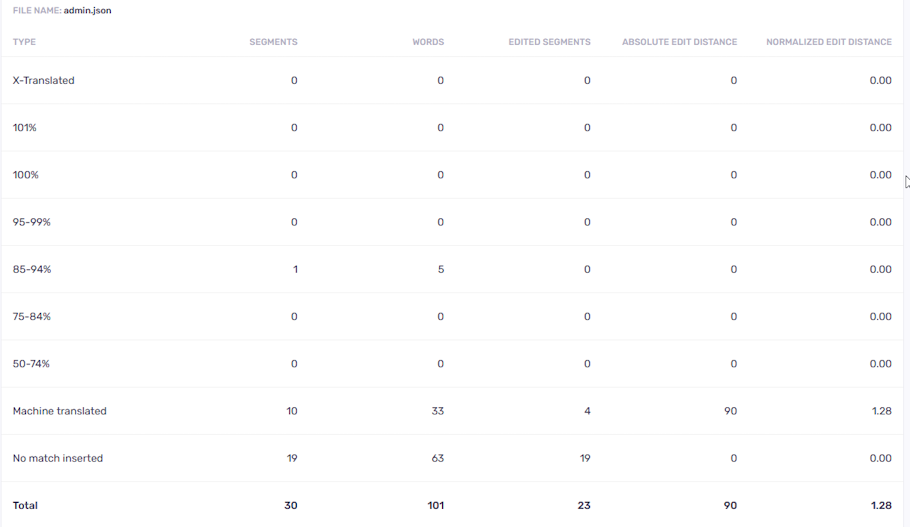
When this option is checked, memoQ calculates statistics for each file and creates a file summary for all of them.
To get the amount of work in characters, use the Levenshtein method to measure the distance. This method makes more sense when you need to see how much a translator worked - not how much of the inserted text was changed. This is because in an average translation job, many segments are translated from scratch, without inserting a match first.
Use Fuzzy only if the work was similar to editing: Counting in percent is useful if there was a match for most segments. This happens if you update a translation to a new version, and there is little difference. Or, when there was machine translation and post-editing.
Don't use Trados 2007-like word counts: By default, memoQ counts words like Microsoft Word does. Use the Trados 2007-like word counts only if your client still works with an early Trados version.
Choose the settings for a progress report
In the Report type section, choose Progress from the dropdown.
A progress report is an overview how much of a project is done (in segments, words, and characters). It gives you a breakdown by segment status.
-
Choose if spaces matter in character count (they normally do): clear the Include spaces in character counts checkbox only if it is really necessary.
memoQ counts every space separately. Two spaces right after each other count as two, not one.
-
Choose how memoQ counts words:
Don't use Trados 2007-like word counts: By default, memoQ counts words like Microsoft Word does. Use the Trados 2007-like word counts only if your client still works with an early Trados version.
-
Choose how memoQ counts tags:
Some document formats bring along a lot of inline tags in the text. Such formats are XML, HTML, PDF, InDesign, sometimes Microsoft Word - and potentially many others.
Inserting these tags in the right places can be a lot of work. The analysis report must reflect that.
By default, memoQ counts tags, but in a separate column. The number of tags is not easy to include in the final word count.
To set this up, you can count tags as words or characters.
You can also count this with the characters. Type a number in the characters box. For example, if you type 2, memoQ counts two characters after every tag.
Choose the settings for a post-translation analysis (PTA) report
In the Report type section, choose Post-translation analysis from the dropdown.
Post-translation analysis gives you the actual savings. It is also useful for finding out how much each translator can bill.
-
Leave the Count repeated 100% matches as repetitions checkbox selected.
-
Choose if spaces matter in character count (they normally do): clear the Include spaces in character counts checkbox only if it is really necessary.
memoQ counts every space separately. Two spaces right after each other count as two, not one.
-
Choose how memoQ counts words:
Don't use Trados 2007-like word counts: By default, memoQ counts words like Microsoft Word does. Use the Trados 2007-like word counts only if your client still works with an early Trados version.
-
Choose how memoQ counts tags:
Some document formats bring along a lot of inline tags in the text. Such formats are XML, HTML, PDF, InDesign, sometimes Microsoft Word - and potentially many others.
Inserting these tags in the right places can be a lot of work. The analysis report must reflect that.
By default, memoQ counts tags, but in a separate column. The number of tags is not easy to include in the final word count.
To set this up, you can count tags as words or characters.
You can also count this with the characters. Type a number in the characters box. For example, if you type 2, memoQ counts two characters after every tag.
Choose the settings for a tracked changes report
In the Report type section, choose Tracked changes in documents from the dropdown.
To give you an idea of how much of the translations the reviewers had to change, this setting compares the documents that the translator, the reviewer 1, and the reviewer 2 delivered.
-
Choose whose work to see:
Under Compare delivered versions, choose an option:
-
Reviewer 1 vs. translator: Shows the changes done by Reviewer 1. Useful for PMs to see how much the reviewer worked and how well the translator did their job.
-
Reviewer 2 vs. translator: Shows the changes done by both reviewers. Useful for the translator to see the improvements the reviewers made, and to learn from them.
-
Reviewer 2 vs. reviewer 1: Shows the changes done by Reviewer 2. Useful for PMs to see how much the 2nd reviewer worked and how well the 1st reviewer did their job. Also useful for the 1st reviewer to see the improvements the 2nd reviewer made.
-
-
Choose what each report contains:
-
A separate report for each reviewer: Creates one report for each reviewer. Useful for PMs to see the individual reviewers' work.
-
A separate report for each translator: Creates one report for each translator. Useful for PMs to see the individual translators' work.
-
A separate report for each target language: Creates one report for each target language. Useful for PMs to see the translation quality of different languages.
-
One combined report for all users and languages: Creates a single report. Useful for PMs to avoid having too many reports and for translators to see the improvements the reviewers made to their translations.
-
Choose the settings for an LQA overview report
In the Report type section, choose LQA overview from the dropdown.
memoQ knows about Linguistic Quality Assurance. This is a way of adding human feedback to documents. The human reviewers can structure and formalize their feedback, and grade the translations if necessary. You use the LQA options - LQA models - to enter these and report about them. An LQA model defines error categories. You can use these to score the errors, grade the translations. Some models allow you to fail a translation.
An LQA overview report sums up the reviewers' feedback about the translation of the whole project. It lists each document in the project, and tells if they passed or failed the review.
Before you create an LQA overview report, add an LQA model to the project in the memoQ desktop app. Otherwise, the report will be empty.
-
Choose how memoQ counts words:
Don't use Trados 2007-like word counts: By default, memoQ counts words like Microsoft Word does. Use the Trados 2007-like word counts only if your client still works with an early Trados version.
Choose the settings for an LQA statistics report
In the Report type section, choose LQA statistics from the dropdown.
memoQ knows about Linguistic Quality Assurance. This is a way of adding human feedback to documents. The human reviewers can structure and formalize their feedback, and grade the translations if necessary. You use the LQA options - LQA models - to enter these and report about them. An LQA model defines error categories. You can use these to score the errors, grade the translations. Some models allow you to fail a translation.
An LQA overview report sums up the reviewers' feedback about the translation of the whole project. It lists each document in the project, and tells if they passed or failed the review.
Before you create an LQA statistics report, add an LQA model to the project in the memoQ desktop app. Otherwise, the report will be empty.
-
Check the Show results for each file checkbox to create a separate report for each file you have in the project.
-
Choose how memoQ groups errors:
By default, memoQ groups (and counts) the errors by categories. (For a list of categories, open the LQA model for editing in the desktop app.) You can change this and group the errors by severity. Or, to not group the errors, choose Show all details.
-
Choose how memoQ counts words:
Don't use Trados 2007-like word counts: By default, memoQ counts words like Microsoft Word does. Use the Trados 2007-like word counts only if your client still works with an early Trados version.
Choose the settings for an LQA error list report
In the Report type section, choose LQA error list from the dropdown.
memoQ knows about Linguistic Quality Assurance. This is a way of adding human feedback to documents. The human reviewers can structure and formalize their feedback, and grade the translations if necessary. You use the LQA options - LQA models - to enter these and report about them. An LQA model defines error categories. You can use these to score the errors, grade the translations. Some models allow you to fail a translation.
An LQA error list report shows all the errors the reviewers recorded when reviewing the translation of the whole project.
Before you create an LQA error list report, add an LQA model to the project in the memoQ desktop app. Otherwise, the report will be empty.
This report has no settings.
Add a comment to the report
In the Description section, type something into the text field if needed. After you create the report, an info  icon will appear after the report's name. To see the description, hover your mouse over the icon.
If you create many reports of the same kind in a project, you can use descriptions to find a report more easily.
When you finish
-
To create the report with the settings you chose: Click the Create report button.
When the report is ready, a message appears. Click its Preview report link to see the report.
-
To return to the Reports page and not create a report: Click the Cancel link.