

Microsoft Word 97–2003 (DOC)
Microsoft Word documents are the most common documents that get translated. In this window, you can control how memoQ imports documents from Microsoft Word 2003 or earlier (these are *.doc or *.dot documents).
This window is for documents from Word 2003 or earlier: Use it to import .doc or *.dot files.
How to get here
- Start importing a document from Word 2003 or earlier (a .doc file).
- In the Document import options window, select the Word documents, and click Change filter and configuration.
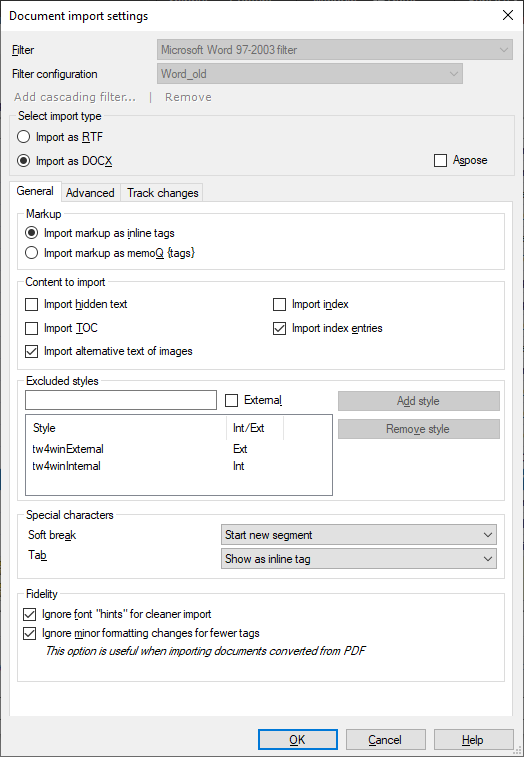
- The Document import settings window appears. From the Filter drop-down list, choose Microsoft Word 97–2003 filter.
What can you do?
First, memoQ converts the document into the DOCX format (the one used by Word 2007 or later).
Under Select import type: Click Import as DOCX. Do not click Import as RTF.
This works if Word 2007 or later is installed on your computer. memoQ calls Word to save the document in the newest format.
If Word 2007 or later isn't installed: Select the Aspose checkbox. In this case, memoQ converts the document into the newest format on its own. For that, memoQ uses a module called Aspose.
Click Import markup as inline tags. The other option is to import all formatting markup as legacy memoQ {tags}, which is not recommended.
 Import or ignore hidden text, the table of contents, the index, or the index entries
- Import hidden text: Allows you to import text that is there in the Office document but formatted to be invisible.
Import TOC: Allows you to import the table of contents. In Word, the TOC is a field that is generated automatically from the document's content, so it usually doesn't need translation.
- Import alternative text of images: Allows you to import ALT text. This feature is important for screen reader users as they use ALT texts in their everyday work.
Import index Allows you to import the index. In Word, the index is a field that is generated automatically from the document's content, so it usually doesn't need translation.
Import index entries: Allows you to import the fields in the Office document's text that mark the words or expressions that get in the index.
Exclude text by style formatting
memoQ can exclude text that is formatted in a specific style. For example, a technical document may include program code that mustn't be translated. The program code is formatted in a different style. You list that style here, so memoQ protects (or doesn't even import) those parts, and translators can't mess them up.
memoQ doesn't read the styles' names from the document, so you need to type them exactly. Before you add one to the list, open the document in Word, and double-check.
There are two types of excluded parts:
- Internal: This is text formatted with a character style. It usually marks an expression inside a segment that is formatted differently. Example: A reference to a part of program code in a sentence. When memoQ excludes text in an internal style, that part is replaced with an inline tag.
- External: This is text formatted with a paragraph style. Example: A complete snippet of program code in the middle of the document. When memoQ excludes text in an external style, that text isn't imported.
To add a style to the list:
-
Type the style's name in the text box above the list.
-
If it's an external style: Select the External checkbox.
-
Click Add style.
To remove a style from the list: Select it. Click Remove style.
Legacy Trados markup styles are in the list: memoQ excludes parts that are formatted in the tw4winInternal and the tw4winExternal styles if you don't change these settings.
Manual line breaks, tab characters: New segment or inline tag, or both?
Under Special characters, choose how memoQ imports manual line breaks (soft breaks) and tabulators. In Word, a paragraph break always means the end of a segment, but a manual line break (Shift+Enter in Word) doesn't end a paragraph.
The tab character jumps to a given position in a line. It can be used to write up text that looks like tables. It is also used to indent the first lines in paragraphs that have a hanging indent.
In memoQ, both characters can mean the end of the segment, and they can also be inserted as inline tags.
memoQ usually starts a new segment at manual line breaks, and shows tabs as inline tags. To change this, an option from the Soft break and Tab dropdowns:
-
Start new segment: memoQ starts a new segment at the manual line break or tab character.
-
Show as inline tag: memoQ shows the manual line break or tab character as an inline tag.
-
Show as inline tag and start new segment: memoQ shows the manual line break or tab character as an inline tag, and starts a new segment as well.
Reduce the number of tags
When you import a Word document, there can be too many tags, especially if the Word document was converted from a scanned PDF.
You have two options to get a cleaner import:
-
Ignore font "hints" for cleaner import: Don't clear this checkbox. The main font may need to change when you are translating from Arabic or an Asian language into a European language. The source text may still contain some Latin words. Before memoQ introduced the font substitution option, every switch between the Latin and Arabic/Asian characters resulted in tags in the imported source text because MS Word automatically changed fonts there.
In many cases, you do not need these font changes in the target text. If you are translating from Japanese (with some English words like company names etc. interspersed) into English, the translated text won't contain any Japanese characters. But in Word, a formatting instruction can have information like "use this font if the part of text is Asian, but use that font if it is Latin." There is also a "hint" attribute for each part of text that tells Word about the type of script a part of text has (Asian, Arabic, etc). memoQ ignores the "hint" attribute if you select this checkbox. The attribute won't make sense in the translated text. It's very likely that the script will change because you translate from Japanese to English.
- Ignore minor formatting changes for fewer tags: Select this checkbox when you work with a scanned document or a document converted from a PDF file. It reduces the number of tags in your document. memoQ ignores formatting changes such as baseline shifts, character spacing changes, and character compression.
Import or ignore comments
A Word document may contain a lot of comments. You can decide what happens to them.
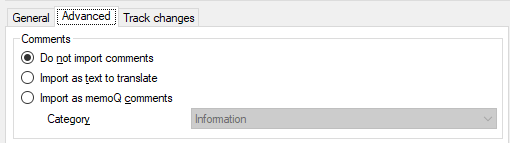
memoQ doesn't import comments from Word documents unless you say so.
To change this: First, click the Advanced tab.
-
To import Word comments as memoQ comments, click Import as memoQ comments. Then, select a type from the Category dropdown. You can select Information, Warning, Error, or Other. If a comment refers to a part of a segment, memoQ adds it to that specific part of the source text. If it refers to text across multiple sentences, memoQ adds it as a segment-level comment to all affected segments.
-
To import Word comments as translatable text, click Import as text to translate. Each comment is added as a separate segment for translation.
If you import hidden text, any comments attached to that text are also imported.
memoQ can export comments into translated Word documents. By default, memoQ comments aren't exported. To make memoQ export comments: Open Options. Choose Miscellaneous. Click the Translation tab. Choose what types of comments you want to export.
Tell memoQ which numbering formats to import
You can choose to import all automatic numbering formats, or only those that are used in the document.
To set this up: Click the Advanced tab.

You have three choices:
- Import all number formats (even unused ones): memoQ imports all the numbering formats from the document's styles.
- Import used number formats only; they will be collected at the end of the document: memoQ imports only the numbering formats that appear in the Word document. You can find them in the last segments of the imported document.
- Import used number formats only; they appear in the document when they are first used: memoQ imports only the numbering formats that appear in the Word document. You can find them at their first occurrence in the imported document. This is the default choice.
Deal with content that only work in Word 2010 and newer
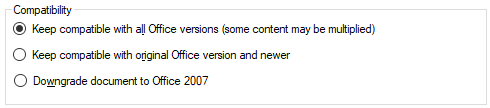
After you translate an old-style Word document, memoQ converts it back to the old format when the translation is exported.
Because the original document is from an old Word version, there will be no extensions that work in Word 2007 or later only.
You can safely ignore the settings in the Compatibility group.
When you finish
-
To confirm the settings, and return to the Document import options window: Click OK.
In the Document import options window: Click OK again to start importing the documents.
-
To return to the Document import options window, and not change the filter settings: Click Cancel.
-
If this is a cascading filter, you can change the settings of another filter in the chain: Click the name of the filter at the top of the window.